

Building a Fraud-Proof, Scalable CPA Practice with ERP Banking
April 7, 2026
Is your CPA firm struggling to keep up with client expectations? You’re not alone.
Many CPA firms struggle as client expectations outpace internal workflows. Modern businesses are now demanding real-time visibility and seamless automations—workflow optimizations historically achieved only through a direct integration with banking partners. While a logical solution for enterprise-sized clients (with enterprise-sized budgets), the cost-benefit analysis of investing in a similar solution for CPAs specializing in project-based or seasonal clients simply isn’t there.
On the flipside, CPAs that continue to rely on traditional, manual workflows aren’t fairing much better. Stuck in a constant loop of inefficiency and frustration, these firms are finding themselves forced into a cycle of problematic workarounds, including:
- Manually downloading and uploading sensitive CSV files and managing a “password graveyard” of bank credentials—all of which can introduce significant human error and fraud risk.
- Toggling between separate bank portals and ERP environments, a process that adds time and fatigue, leaving CFOs to make decisions based on outdated cash positions.
Stuck between a rock (bank integrations) and a hard place (manual headaches), it’s no wonder CPA firms are growing increasingly frustrated, searching for a way to efficiently unify bank and ERP data.
Can CPAs Scale Without Direct Bank Integrations?
Ask any CPA and chances are good they’ll tell you that direct bank integrations are a necessary evil; on one hand, the data integration can be game-changing for a client, but on the other hand, the hassle of achieving this connectivity can drive a person crazy. This is why CPAs are longing for a world where complex bank integrations would simply… disappear. In an ideal environment, achieving bank connectivity wouldn’t take months and manpower but would simply exist as a built-in utility within the ERP.
This is because a “plugged-in” approach would help achieve three key benefits:
- Instant Reconciliation: Bank data flows directly into the ERP, allowing for “continuous accounting” rather than end-of-month scrambles.
- Elevated Advisory: With manual tasks automated, CPAs shift from data entry specialists to strategic advisors who provide proactive cash flow insights.
- Compounded Security: Efficiency and control reinforce one another. Automation creates clearer audit trails and uses bank-managed entitlements to ensure the right people have the right access, every time.
With this approach, CPAs would no longer have to act as the technical consultant or IT support because the implementation would have a low-to-zero implementation burden. The architecture would be directly embedded inside the ERP, reducing logins and third party applications. And above all else, it would utilize the bank’s existing security layers (like Multi-Factor Authentication and entitlements) rather than bypass them. When it comes to an ideal future, CPAs are looking for technology that respects not just their time, but also their clients’ stringent security requirements.
It’s a big ask, but what if we told you not only is it possible, but it already exists?
ERP Banking for CPAs
ERP Banking bridges the gap between the bank and the ERP, turning what used to be a months-long implementation project into a simple plug-in installation.
Take FISPAN, for example. Our platform handles the heavy lifting of the integration layer, allowing CPAs to manage multiple client entities through a centralized, embedded experience. By removing the technical barrier, FISPAN unlocks all the benefits of bank integration for seasonal or project-based engagements, while simultaneously removing all of the technical and administrative hassles. The result?
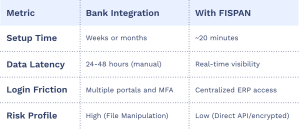
The question for CPAs is no longer whether a bank integration is feasible; instead, they can focus on providing their clients with proactive advisory services and optimized workflow recommendations.
“We built the integration so you don’t have to worry about implementation — it’s a 20-minute installation, not a project.”
— Zack Manning, SVP of Revenue / FISPAN
Curious how this works in practice?
Looking for a CPA banking integration alternative that reduces technical requirements and increases workflow efficiencies? We’re happy to walk through how ERP banking is being used by CPA firms today to balance automation with ironclad controls.
Connect with FISPAN’s partnership team to explore what this could look like for your firm.
CPA Frequently Asked Questions
Q: How can a CPA justify an ERP banking integration for seasonal or project-based clients?
A: Traditional bank integrations used to come with a heavy technical implementation burden, one that was shouldered entirely by the CPA. FISPAN’s modern ERP banking integration removes this burden entirely, whereby the FISPAN team handles all of the heavy lifting. Setup becomes an installation that is often measured in minutes rather than weeks. When the time burden drops, implementation becomes realistic even for seasonal engagements.
Q: How important is bank connectivity to modern CPA firms?
A: Bank integration is no longer just an operational upgrade. It’s becoming part of the advisory conversation. When banking data flows directly into the ERP reconciliation speeds up, and cash visibility improves, manual errors decline. This enables CPAs to take a more proactive approach with their clients, elevating the value they deliver to CFOs and finance teams.
Q: Is bank integration worth it for CPA firms?
A: A modern ERP banking solution makes bank integration worthwhile for CPA firms in two ways. First, the integration provides a number of benefits, including strengthening security through automation, improving operational efficiency by reducing manual work and consolidating logins, and elevating advisory services by speeding up reconciliation and improving cash visibility. Second, an ERP banking solution removes the technical burden that is traditionally associated with direct bank integrations. Direct bank integrations, while possible, are complex projects that require a great deal of time, resources, and support from CPA firms. As such, they are not normally recommended.
Q: Why is FISPAN the right ERP banking integration solution for CPAs?
A: FISPAN’s ERP banking integration injects seamless, secure financial capabilities directly into the systems your accountants already live in: the ERP and accounting platforms. It’s not another application; it is the total unification of your ERP and your bank. This plug-and-play approach removes the cost and technical burden of stitching together multiple systems, instantly making powerful automation available to clients of all sizes.
About FISPAN
FISPAN, the industry leader in banking connectivity, partners with financial institutions to provide turnkey solutions that seamlessly integrate with enterprise resource planning (ERP) and accounting software. These integrations automate workflows, enhance visibility, and strengthen security for businesses. With over 5,000 businesses on its platform and an annual payment volume exceeding $100 billion, FISPAN continues to set the standard for banking connectivity solutions.