
AI-assisted treasury: Embedded banking and the human-in-the-loop workflow
By Niki Acosta, Executive Director, Head of Digital and Payments Solutions at J.P. Morgan | October 28, 2026
In our previous blog posts related to our recent webinar, we explored technical pathways for modernizing bank-ERP integrations and the change management strategies required to adopt them. As finance teams move toward advanced automation, a critical question emerges: How do we leverage Artificial Intelligence (AI) without losing control?
The answer lies in embedded banking and the human-in-the-loop framework. By bringing banking services directly into the digital environments where businesses already operate, organizations can automate finance workflows and reduce manual processes securely.
Why 79% of CFOs view AI as a strategic treasury imperative
The future of finance is happening right now. Recent market data reveals that 79% of CFOs currently place AI and automation within their top three strategic investments for business transformation. And, 89% of finance professionals said AI is helping to both increase annual revenue and reduce annual costs. So, clearly AI is not going anywhere.
As treasury teams move from pilot programs to scaled adoption, the focus is shifting. Finance leaders want to automate tasks that take up valuable time and manpower while also building systems that are trusted, controlled, traceable, and repeatable.
The four pillars of AI trust and governance in corporate treasury
In treasury and payments, actions are often non-reversible. Granting AI unchecked authority can lead to incorrect results at a massive scale. To confidently adopt these tools, organizations must anchor their workflows in four practical principles:
- Human-in-the-loop: AI should be used to recommend and prepare data, while human professionals must always verify and approve the final decisions, especially for high-impact outcomes.
- Control scope and safe defaults: Systems must be constrained by safe defaults. Irreversible actions must remain strictly behind approval gates, requiring explicit confirmation for any exceptions.
- Data quality and transparency: AI outcomes are only as good as their inputs. Robust validation and monitoring are required to prevent inaccurate outputs and control failures.
- Traceability and accountability: Clear ownership and comprehensive audit trails are mandatory. Stakeholders must always be able to easily understand what changed, why it changed, and who approved it.
By embedding these core governance pillars into everyday operations, organizations create the secure, reliable foundation needed to redefine key roles across their finance function.
How human-in-the-loop workflows turn finance teams into strategic reviewers
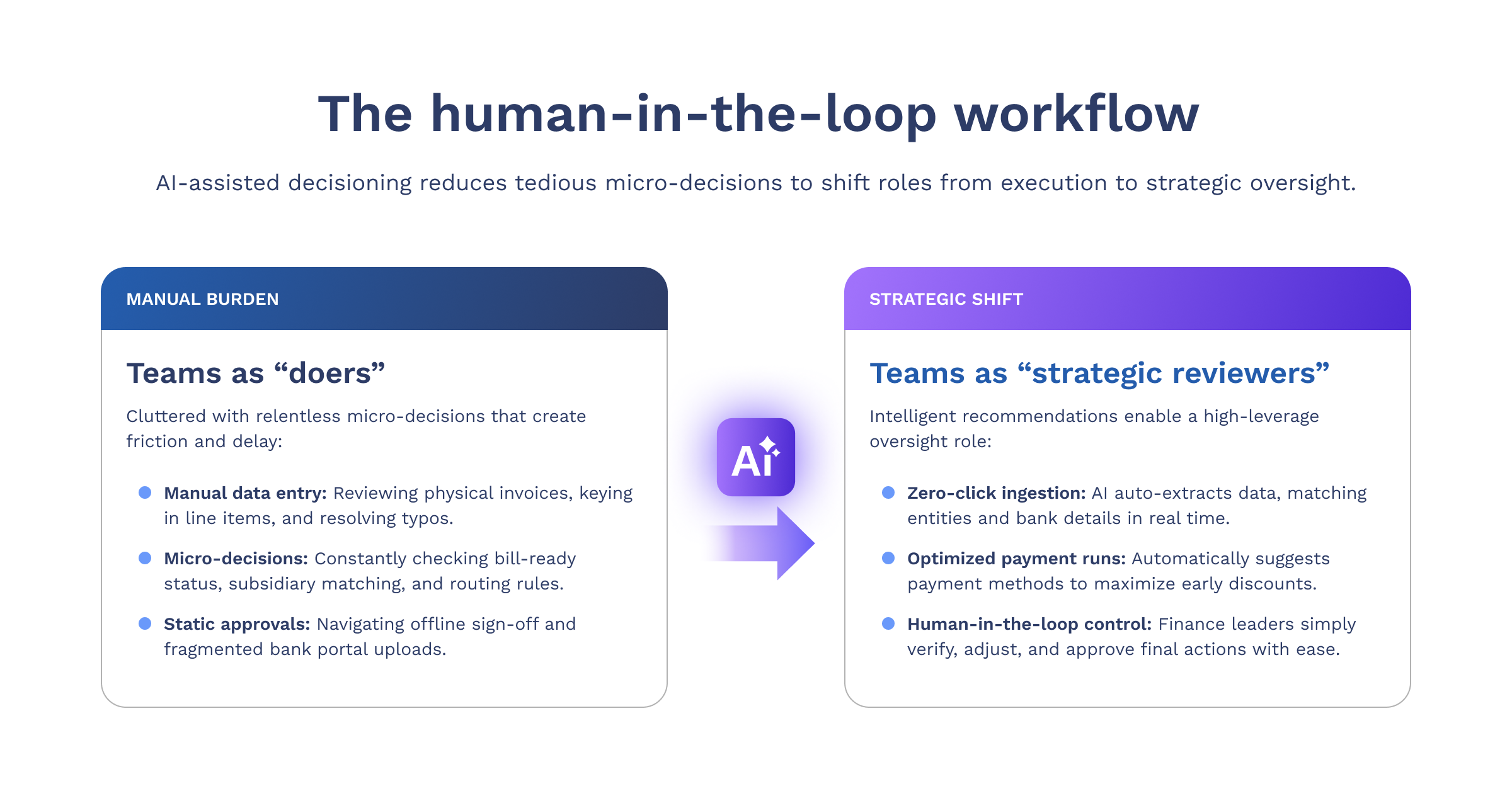
Embedded banking fundamentally changes how teams operate. When paired with AI, this integration elevates the role of the finance professional. The human-in-the-loop workflow shifts teams from being bogged down “doers” to operating as high-leverage “strategic reviewers.”
Instead of dealing with the manual burden of reviewing physical invoices, keying in line items, and navigating fragmented bank portals, teams benefit from zero-click ingestion where AI auto-extracts data and matches entities and bank details in real time.
The system can automatically suggest optimized payment methods to maximize early discounts, allowing finance leaders to simply verify, adjust, and approve the final actions with ease.
Case study: transforming cash forecasting with AI and human accountability
I recently worked with a global software company struggling with cash forecasting and real-time liquidity visibility. Like many organizations, their team relied on manual workflows, regularly exporting core cash flow metrics to manage forecasts entirely in complex spreadsheets.
To solve this, the company transitioned its core cash flows into an AI-assisted cash flow intelligence tool. By leveraging machine learning-driven forecasting, they successfully cleaned up their manual processes.
However, the key to their success was the practical application of AI guardrails. They reduced complexity by replacing hundreds of manual tasks with a smaller set of automated rules. Crucially, they maintained clear human ownership over those rules, ensuring full traceability of what was adjusted and why.
The result was highly meaningful: a massive reduction in time spent on data entry, and the creation of a governed, explainable forecasting process that financial leadership could completely trust. It proved that the combination of an AI skill and human accountability is the blueprint for successfully applying these tools.